Views: 0 Author: Ronix Tools Publish Time: 2026-11-05 Origin: Site


Walk into a professional workshop or construction site, and you will probably find several power tools being used at the same time. A carpenter may be drilling holes in wooden panels, an electrician may be installing cable supports, while another worker is cutting metal brackets nearby. Each task requires a different tool, but that does not mean every worker needs to carry an entire workshop around.
This is where the idea of a do it all power tool becomes interesting.
For homeowners, it usually means finding one machine that can handle most repair and improvement projects. For contractors and professional users, the question is slightly different: which tools offer enough versatility to cover everyday work without adding unnecessary equipment?
There is no universal answer. A cordless drill might be the most useful tool in a general toolbox, while an angle grinder or oscillating multi-tool could be more valuable in a specialized trade.
Let's look at what makes a power tool genuinely versatile, which machines deserve a place in a professional toolbox, and what buyers should consider when building a practical cordless tool collection.
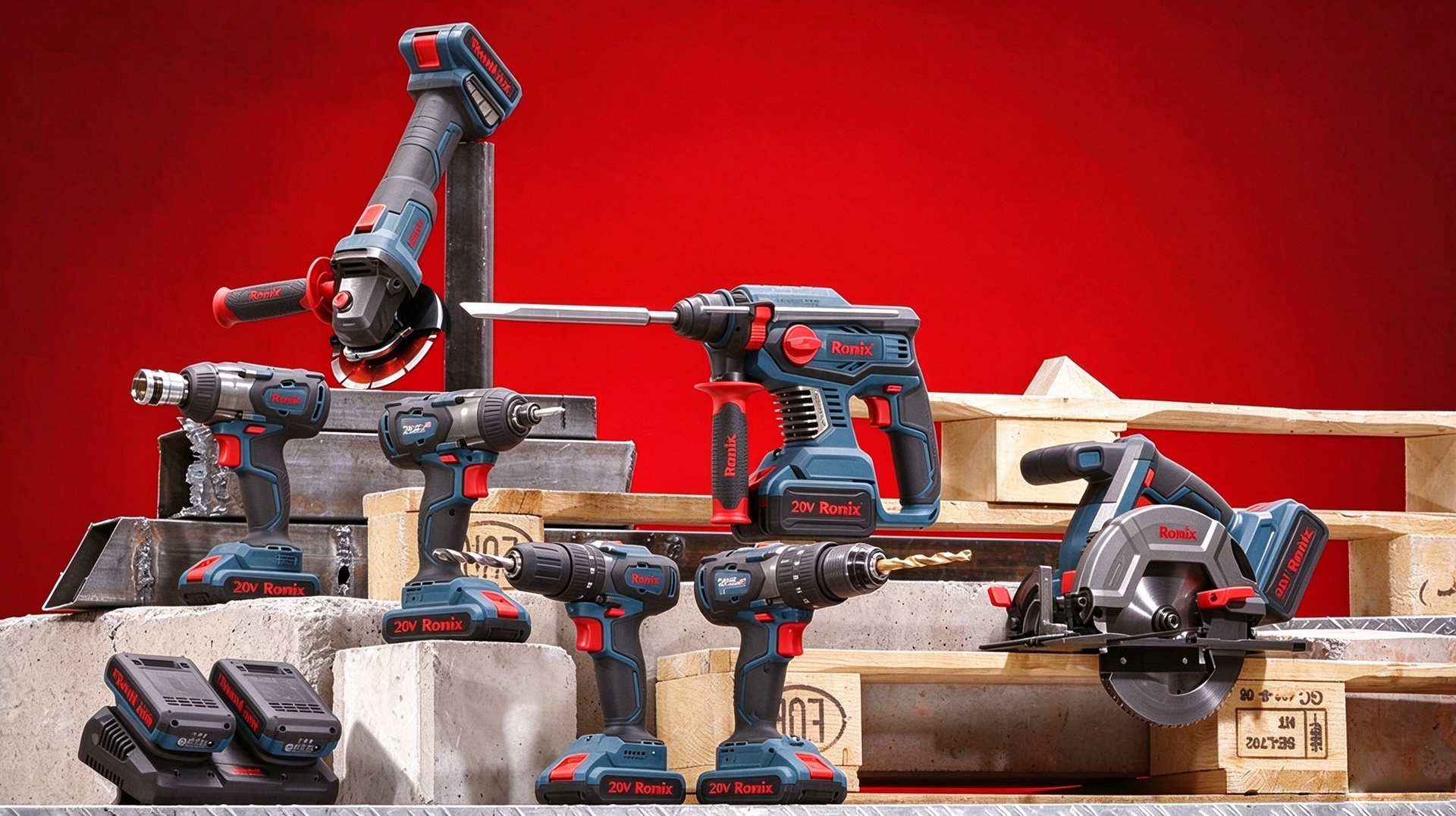
A power tool does not become versatile simply because it has a powerful motor or an impressive list of specifications. Its real value comes from how many useful jobs it can perform reliably.
Take a cordless drill driver as an example. With the right accessories, the same machine can drill pilot holes, install screws, assemble furniture, and carry out routine maintenance. It is useful in workshops, on construction sites, and even in vehicle maintenance.
However, versatility also depends on a few practical details.
Compatibility with accessories: A tool that accepts different bits, blades, or attachments can cover more applications without requiring another machine.
Power control: Variable speed and adjustable torque allow users to work with different materials without damaging the workpiece.
Portability: A compact, cordless design makes it easier to move between work areas and reach locations where electrical outlets are unavailable.
Operating comfort: Weight, grip design, vibration, and switch placement become increasingly important during extended working hours.
Reliability: A tool intended for daily professional use must maintain consistent performance under regular workloads.
For buyers, these details are often more meaningful than choosing a machine based on its maximum advertised power alone.
Some machines are naturally more adaptable than others. The following five tools are worth considering when building a toolbox for general maintenance, construction, woodworking, and metalworking.
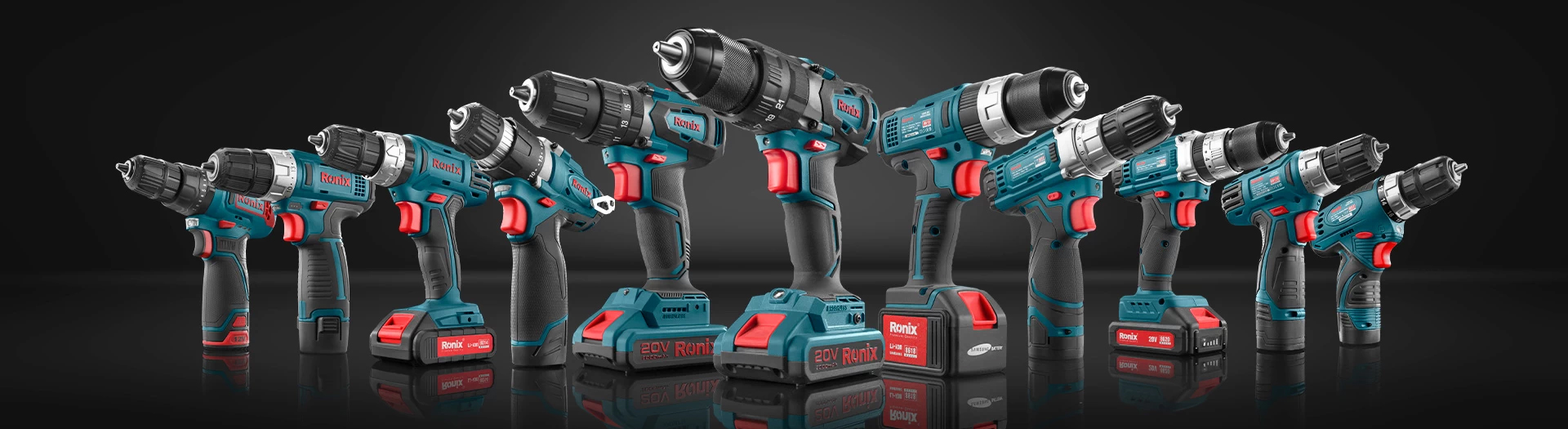
If there is one machine that belongs in almost every toolbox, it is a cordless drill driver.
Its popularity comes from a simple fact: drilling and fastening are part of countless jobs. Furniture assembly, cabinet installation, electrical fitting, equipment maintenance, and general construction all involve these operations.
A cordless drill driver can handle:
Drilling holes in wood, plastic, and metal with suitable drill bits.
Installing and removing screws.
Assembling furniture and cabinets.
Fixing brackets, fittings, and mounting hardware.
Carrying out routine workshop maintenance.
Modern models often feature variable speed control, adjustable torque settings, forward and reverse functions, and built-in LED lighting.
For demanding applications, a brushless impact drill offers another level of performance. Its motor design eliminates carbon brushes, reducing one source of mechanical wear and the need for brush replacement.
The Ronix 8900, for example, is a 20V brushless cordless impact drill with a 13 mm chuck and 45 N.m torque. It is designed for users who need a cordless machine for regular drilling and fastening operations.
For general contractors, furniture manufacturers, and maintenance teams, this type of tool is often a sensible starting point.

Some jobs are too small or awkward for a circular saw, angle grinder, or conventional sander. An oscillating multi-tool is particularly useful in these situations.
Instead of rotating continuously, its accessory moves back and forth at high speed. This makes it suitable for detailed work where controlled movement matters.
Depending on the installed attachment, users can:
Cut small sections of wood and plastic.
Trim door frames and flooring materials.
Remove old adhesive and sealant.
Scrape paint and other surface materials.
Sand corners and difficult-to-reach areas.
A renovation contractor might use an oscillating tool to trim a door frame without removing the entire structure. A flooring installer may need it to make small adjustments around pipes or wall edges.
It is not a replacement for heavy cutting equipment, but it can save considerable time when working in confined spaces.

An angle grinder is another machine with a surprisingly broad range of applications.
Although many people associate it with cutting metal, changing the accessory can turn it into a tool for grinding, cleaning, and surface preparation.
Common applications include:
Cutting steel bars and metal pipes.
Grinding weld seams.
Removing rust and surface coatings.
Cleaning metal surfaces with suitable attachments.
Preparing materials before welding or assembly.
The type of disc matters. Cutting discs, grinding wheels, wire brushes, and polishing accessories are designed for different operations and should never be used interchangeably.
Cordless angle grinders are particularly convenient for installation crews and maintenance workers who frequently move between workstations.
The Ronix 8901K is a 20V brushless cordless mini angle grinder kit with a 115 mm disc. Its compact format makes it a practical option for users who need a portable grinder for compatible cutting and grinding applications.

When a project involves cutting boards, plywood, or construction lumber, a circular saw is usually a better choice than trying to adapt another machine.
It is designed for straight cuts and can handle repetitive cutting operations more efficiently than many general-purpose tools.
Typical applications include:
Cutting wooden boards to size.
Preparing plywood and sheet materials.
Trimming construction lumber.
Making straight cuts during furniture production.
Preparing materials for interior installation.
Blade selection determines which materials can be processed safely and effectively. Cutting depth and blade diameter should also match the thickness of the workpiece.
For users who regularly work at different locations, a cordless circular saw can make material preparation more convenient.
The Ronix 8902 is a 20V brushless cordless circular saw with a 165 mm blade, designed for woodworking and related cutting applications.

A standard drill may work well on wood and metal, but concrete presents a different challenge.
For drilling into concrete, brick, and masonry, a rotary hammer is the more appropriate choice. Its hammering mechanism helps break through hard materials while the drill bit rotates.
Depending on the operating mode and accessories, a rotary hammer can be used for:
Drilling anchor holes in concrete.
Installing electrical and plumbing supports.
Drilling into masonry walls.
Light chiseling and renovation work.
For contractors, this machine is particularly useful during installation and construction projects.
The Ronix 8910K is a 20V brushless cordless rotary hammer kit with 2.2J impact energy. It provides a cordless option for users who need drilling and light chiseling capabilities on site.
The best do it all power tool depends largely on the work being performed. Buying a machine with functions you rarely use does not necessarily make financial sense.
Here is a quick comparison based on common applications.
| Tool | Best Application | Main Advantage |
| Cordless Drill Driver | General maintenance and installation | Handles drilling and fastening |
| Oscillating Multi-Tool | Renovation and finishing | Works in narrow spaces |
| Angle Grinder | Metalworking and fabrication | Cuts and grinds metal |
| Circular Saw | Woodworking and construction | Makes efficient straight cuts |
| Rotary Hammer | Concrete and masonry | Handles hard construction materials |
For a homeowner, a cordless drill driver may cover most routine projects. A renovation contractor will probably benefit from adding an oscillating multi-tool and angle grinder.
A construction company working with concrete will have different priorities, particularly when rotary hammers are required on a regular basis.
In other words, the right toolbox should reflect the actual workload rather than the number of machines in a product catalog.
There was a time when cordless tools were mainly associated with light-duty work. That perception has changed considerably as battery technology and motor design have improved.
For professionals, the biggest benefit is not simply the absence of a power cord. It is the ability to use different machines without constantly changing batteries, chargers, and accessories.
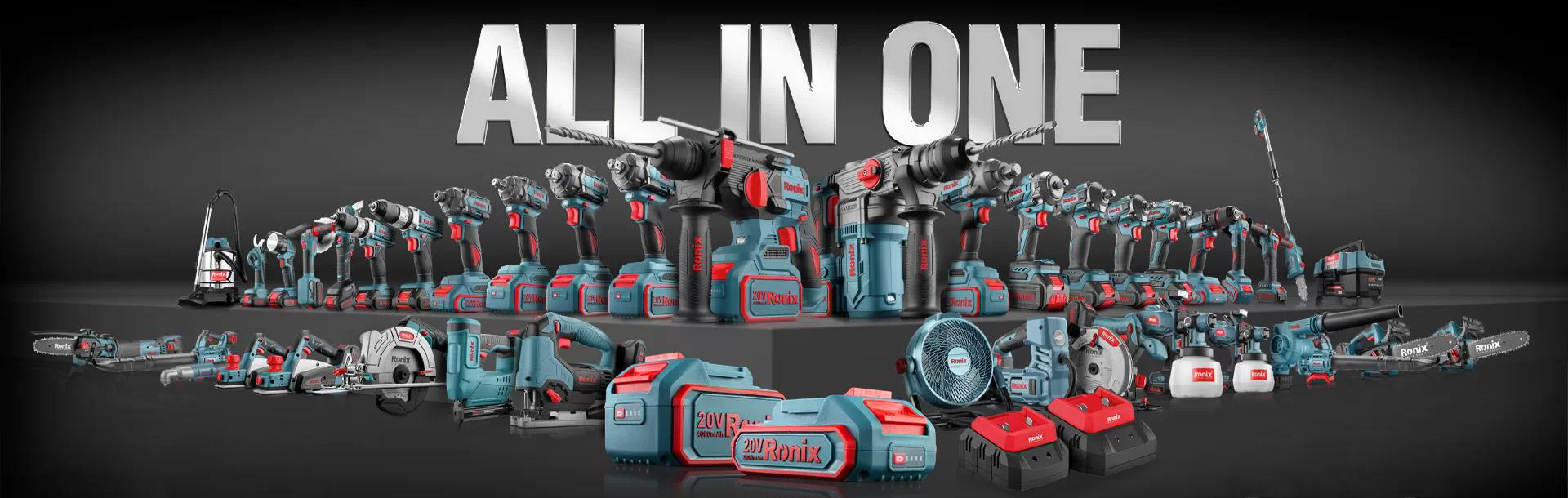
Imagine a contractor carrying a drill, angle grinder, circular saw, and rotary hammer to a construction site.
If every machine requires a different battery and charger, equipment management becomes unnecessarily complicated.
A compatible cordless platform makes things easier. Workers can use batteries across supported tools within the same system, while businesses can simplify their spare battery inventory.
This is also a useful consideration for distributors. Rather than selling individual machines as unrelated products, they can offer a complete cordless collection.
Brushless motors have become increasingly common in professional cordless tools.
Unlike traditional brushed motors, they do not rely on carbon brushes to transfer current to the rotating part. This removes the need for routine carbon brush replacement and can improve overall motor efficiency.
For frequent users, the benefits may include:
Reduced brush-related maintenance.
Better energy efficiency.
More efficient use of battery power.
Less mechanical wear associated with carbon brushes.
Actual performance still depends on the motor design, battery, electronics, and working conditions. A brushless label alone does not guarantee that one tool is better than another.
Cordless equipment is especially useful for outdoor construction, installation work, and maintenance in locations without convenient power access.
Workers can move between floors, buildings, and workstations without constantly relocating extension cables.
That flexibility can make a noticeable difference when a project involves many small tasks across a large area.
For importers and distributors, selecting power tools is not just about finding popular models. The product range must make sense for the local market, customer base, and expected sales volume.
A few purchasing considerations deserve particular attention.
A supplier with only a few drill models may not be able to meet the needs of customers looking for a complete power tool solution.
Look for a product portfolio that covers different applications, including drilling, cutting, grinding, fastening, and concrete work.
This gives retailers more opportunities to serve different customer groups.
Battery compatibility is worth examining before placing a large order.
A cordless platform with several compatible tools can encourage customers to purchase additional machines after their first purchase.
For retailers, this creates opportunities to sell bare tools, battery kits, chargers, and accessories.
Always check the exact voltage platform and compatibility specifications before combining products.
Professional buyers should review more than product photographs and catalog descriptions.
Important information includes:
Motor type and performance specifications.
Battery capacity and charging requirements.
Available accessories.
Product test information.
Applicable market certifications.
Warranty terms and spare parts availability.
The documentation should match the requirements of the destination market.
A tool that sells well in one market may not perform the same way elsewhere.
Some distributors focus on professional-grade products, while others target hardware stores and general consumers.
Product packaging, specifications, accessory combinations, and price positioning should reflect the expectations of the intended customer.
For a distributor, the relationship with a supplier does not end when the goods arrive.
Replacement batteries, chargers, spare parts, product documentation, and technical support all influence the long-term value of a product range.
These factors should be discussed before establishing a regular purchasing arrangement.
For buyers who want to offer more than individual power tools, a coordinated cordless collection can be an attractive option.
The Ronix 89 Series was developed around this idea. It brings together a variety of cordless machines, including brushless models, designed to operate within compatible lithium-ion battery platforms.
The range covers several applications that commonly appear in professional workshops and construction environments.
Some notable 20V models include:
Ronix 8900 – Brushless Impact Drill
A cordless drilling and fastening solution with a 13 mm chuck and 45 N.m torque.
Ronix 8901K – Brushless Mini Angle Grinder Kit
A 115 mm cordless grinder designed for metal cutting and grinding applications.
Ronix 8902 – Brushless Circular Saw
A 165 mm cordless circular saw for woodworking and construction tasks.
Ronix 8907 – Brushless Impact Wrench
A cordless fastening tool intended for applications involving nuts and bolts.
Ronix 8910K – Brushless Rotary Hammer Kit
A cordless rotary hammer with 2.2J impact energy for drilling and light chiseling applications.
The 89 Series has also expanded into 40V cordless equipment for users with more demanding power requirements. Buyers should select the appropriate battery and charger for each voltage platform rather than assuming that all batteries are interchangeable.
For distributors, this range provides a way to approach several customer segments through one product family. A hardware retailer can start with general-purpose drills and grinders, while professional tool dealers can develop a broader offering that includes saws, impact wrenches, and rotary hammers.
Explore the Ronix 89 Series to see the available cordless tools and battery options.
This depends on how frequently the tools will be used.
For someone who only needs a drill for occasional home repairs, buying a complete set may be unnecessary. However, a professional contractor who regularly switches between drilling, cutting, and fastening operations may find a coordinated set more practical.
There are three main advantages worth considering.
Lower Equipment Duplication
A compatible battery system reduces the need to purchase a separate battery and charger for every machine.
Simpler Equipment Management
Using tools from one compatible platform can make it easier to organize batteries, chargers, and replacement equipment.
Room for Future Expansion
Users can add machines as their work requirements change, rather than replacing an entire collection.
For wholesale businesses, the same approach can support product bundling and repeat sales. A customer who initially purchases a cordless drill kit may later return for an angle grinder, circular saw, or additional battery.
That is one reason why cordless tool platforms have become an important part of the professional power tool market.
A cordless drill driver is generally the most practical choice for everyday use because it handles drilling and fastening. Professional users may need additional tools such as an angle grinder, circular saw, or rotary hammer depending on their work.
No. An oscillating multi-tool is designed mainly for cutting, scraping, and sanding. It does not offer the same drilling and screwdriving capabilities as a cordless drill driver.
Many modern cordless tools are suitable for demanding professional applications. Battery technology, brushless motors, and improved electronic controls have made them increasingly capable. The correct model still depends on the workload.
Voltage is one factor in a cordless tool's electrical system and power capability. A 40V platform is generally intended for applications requiring greater power capacity, while 20V tools cover a broad range of everyday and professional tasks. Actual output also depends on motor design, battery characteristics, and tool electronics.
They eliminate carbon brush replacement and can provide improved energy efficiency. These characteristics make them attractive for users who operate their tools frequently and want to reduce routine maintenance.
Importers should compare product coverage, technical specifications, battery compatibility, certifications, packaging, wholesale pricing, delivery arrangements, and after-sales support. A supplier with a coordinated product range can also make future purchasing easier.
There is no single machine that can do everything. A cordless drill driver may be the most useful starting point, but metal fabrication, woodworking, and concrete construction each require equipment designed for their specific applications.
The smarter approach is to build a toolbox around the work that needs to get done.
For individual users, that means choosing tools that offer practical value rather than buying machines they may rarely use. For distributors and importers, it means finding a product range that covers different applications and gives customers room to expand.
With its range of cordless equipment and compatible battery platforms, Ronix provides global buyers with different options for developing a practical power tool collection.
Looking to expand your power tool product range? Visit Ronix to explore its cordless tool collections and discuss sourcing opportunities for your market.